CED Coating (Electrocoating) Services
Uniform, immersion-applied protection for corrosion resistance.
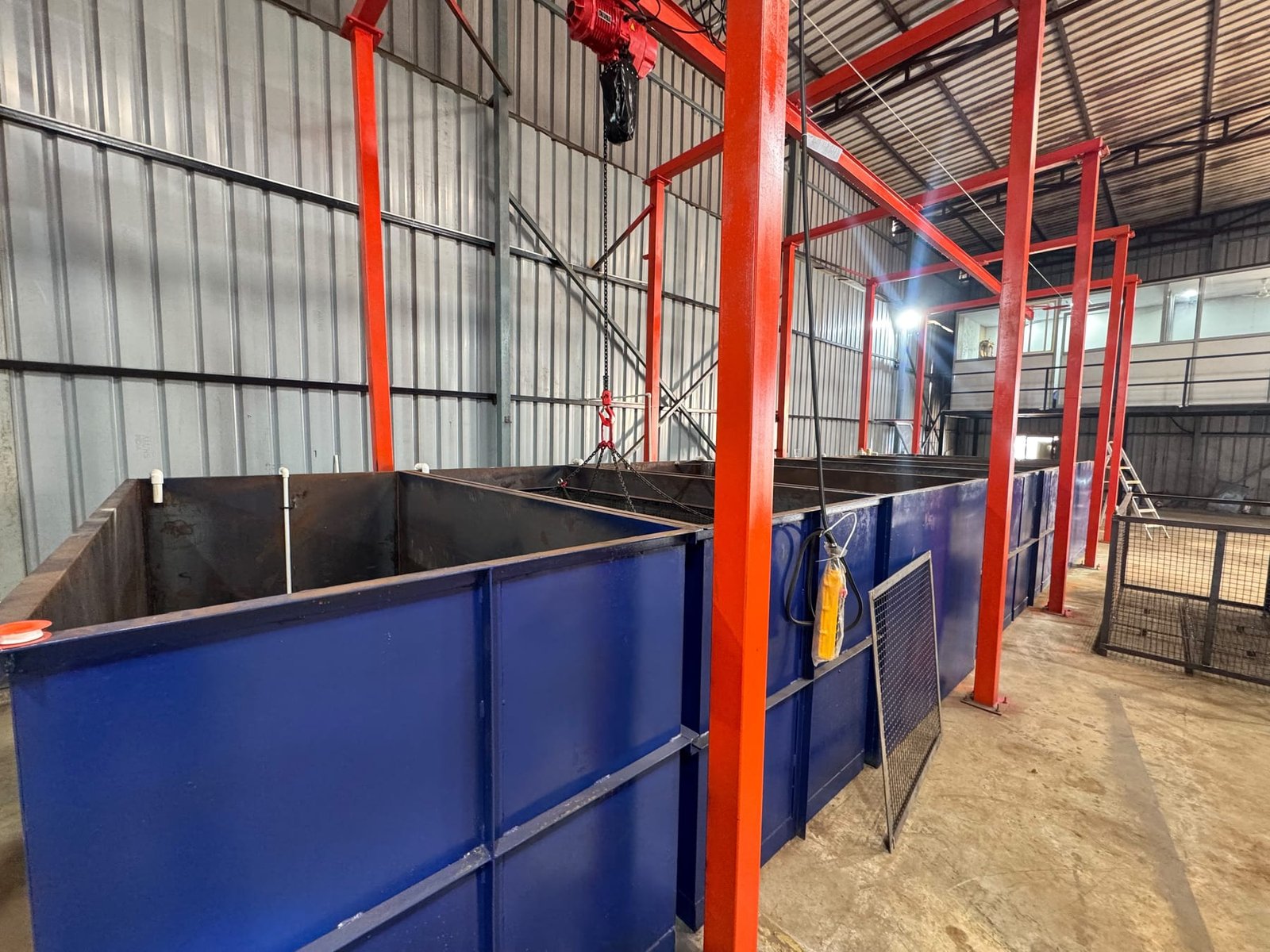
CED coating — short for Cathodic Electrodeposition, also called electrocoating or e-coating — is an immersion coating process known for depositing a highly uniform film even across complex geometries, edges and internal surfaces that are difficult to reach with spray application.
It is widely used across industry as a corrosion-resistant base coating on metal components, particularly where consistent coverage over the entire part — not just the visible faces — matters for long-term protection.
What is CED Coating?
In the CED process, the component is fully immersed in a tank containing a water-based coating solution made up of charged paint particles. An electrical current is applied between the component and the tank, causing the charged particles to migrate through the solution and deposit onto the surface of the part.
Because deposition is driven electrically rather than by line-of-sight spraying, the coating builds up evenly across the whole immersed surface — including cavities, corners and internal areas — which is why CED coating is widely regarded as an effective way to achieve consistent corrosion protection on complex components.
After deposition, the component is rinsed and then cured in an oven, where the coating cross-links into a tough, adherent film.
How the Process Works
A high-level look at how ced coating is applied. Exact parameters are confirmed per job based on the component and substrate.
Pre-treatment
The component surface is prepared so the coating can bond effectively and provide the corrosion resistance the process is known for.
Immersion & electrodeposition
The part is immersed in the coating tank and an electrical charge is applied, drawing coating material evenly onto every wetted surface of the component.
Rinsing
Excess, non-deposited coating solution is rinsed from the component before curing.
Curing
The coated part is cured in an oven, cross-linking the film into a durable, well-bonded coating.
Why Choose CED Coating
- Even film build across the entire immersed component, including recesses and internal surfaces
- Strong base for corrosion protection on metal parts
- Consistent coating thickness compared with line-of-sight spray methods
- Water-based formulation with lower solvent content than conventional liquid paints
Suitable Applications
- Components with complex shapes, recesses or internal cavities
- Parts requiring uniform corrosion protection over the full surface
- Engineering and fabricated metal assemblies
- Components that will be top-coated with a subsequent finish
- General metal parts where consistent coverage is a priority
Process Considerations
- CED coating is applied to electrically conductive substrates, and component design (drain holes, fixture points, immersion access) affects how evenly a part can be coated.
- It is frequently used as a corrosion-resistant base layer, sometimes followed by a top coat depending on the application — discuss your end-use requirement when requesting a quote.
- Share drawings or sample components so geometry and fixturing can be assessed accurately.
Common Questions About CED Coating
What is CED coating?
CED coating, or cathodic electrodeposition coating, is an immersion process in which a component is submerged in a water-based coating solution and an electrical charge deposits a uniform film across the entire surface, including recesses and internal areas.
How is CED coating different from powder coating?
Powder coating is a dry powder applied by electrostatic spray and cured by heat, while CED coating is a wet, water-based coating applied by immersion and an electrical charge. CED is particularly effective at coating complex shapes and internal surfaces evenly, while powder coating is typically chosen for its hard, decorative finish on external surfaces.
Is CED coating good for corrosion protection?
Yes. CED coating is widely used in industry as a corrosion-resistant base coating because the immersion and electrical deposition process gives even film coverage across the whole component, reducing gaps in protection that can occur with line-of-sight spray methods.
What information is needed to quote CED coating?
Component material, dimensions, quantity, geometry (including any internal cavities) and the intended application help in preparing an accurate quote. Drawings or sample parts are useful.